
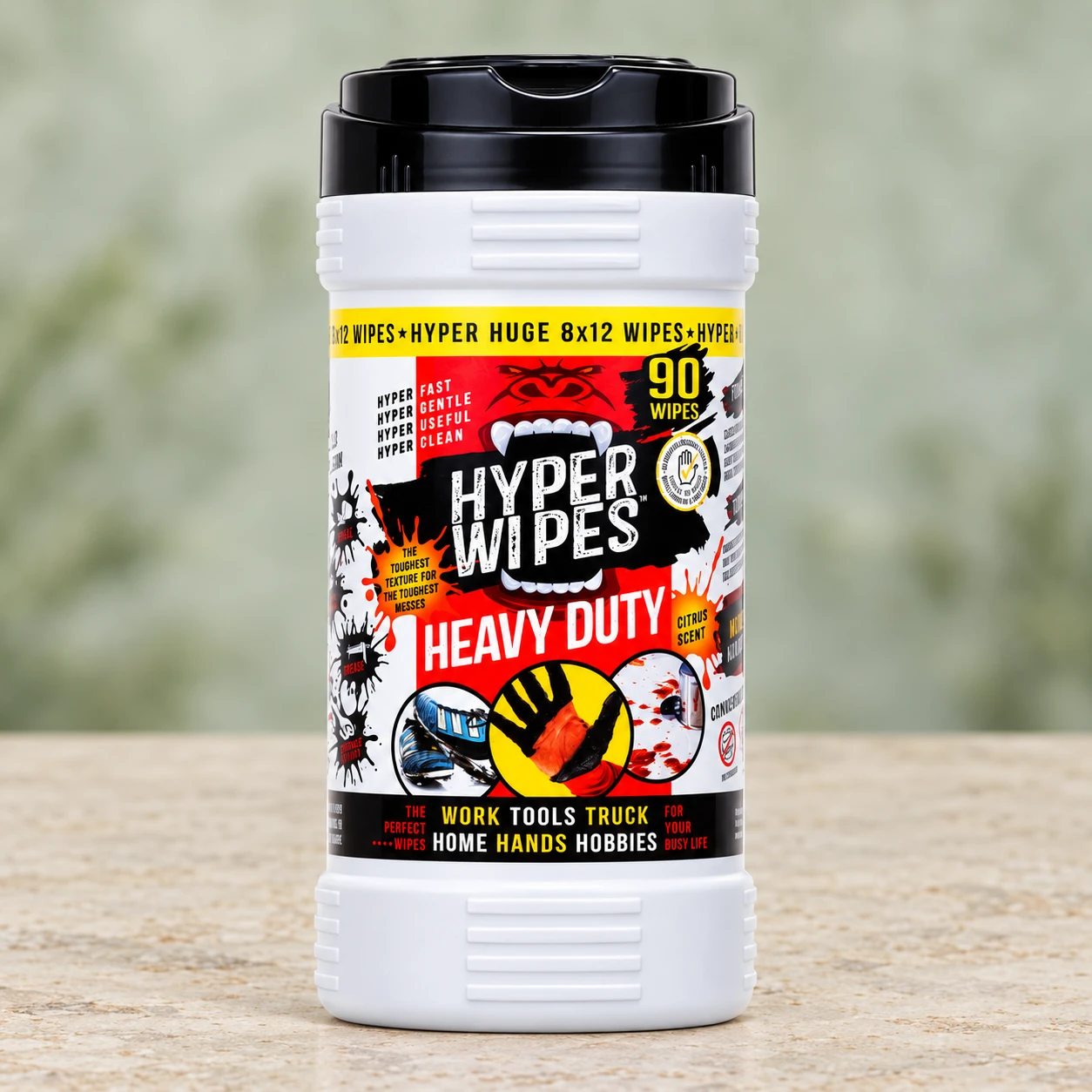
Workshop, maintenance, automotive and DIY cleaning can involve grease, oil, paint, ink and adhesive residues. A household wipe may be designed for a different cleaning task. An industrial wipe combines a cleaning formulation with a nonwoven material and a packaging system. The finished product needs to be evaluated as a whole.
What are heavy duty cleaning wipes?
Heavy duty wipes are pre-moistened wipes developed for demanding cleaning tasks on tools, work benches, equipment and other suitable surfaces. Hand use is a separate requirement: only a product specifically formulated and labelled for hands should be used on skin. The aim is to loosen the contamination, lift it and retain it in the wipe rather than spread it around.
Four parts of the cleaning system
- Cleaning agents: choose the chemistry for the soil and the material being cleaned. More aggressive cleaning is not automatically better.
- Surfactants: help wet the surface and interact with oily dirt. Their level must be balanced against foaming and residue.
- Solvent system: can help soften difficult oily or polymeric residues. Selection must also consider plastics, paint and coatings.
- Nonwoven and liquid loading: texture, absorbency, wet strength and the amount of liquid affect how the wipe performs during use.
Match the wipe to the contamination
| Contamination | What to evaluate |
|---|---|
| Grease and oil | Assess lifting and retention, not just whether the soil dissolves. |
| Paint and ink | Fresh or uncured residues can behave differently from fully cured coatings. |
| Adhesive residues | The formula must loosen the residue while the wipe lifts it from the surface. |
| Sealants and construction grime | Evaluate the actual residue and substrate together; do not assume universal compatibility. |
Scrub or biodegradable nonwoven?
Hyper Wipes offers two wipe options: scrub-textured and biodegradable nonwoven. Choose the material and formulation together for the intended application.
| Wipe option | Selection focus | Confirm before purchase |
|---|---|---|
| Scrub-textured nonwoven | Mechanical action for demanding cleaning tasks. | Texture, wet strength and compatibility with the surface. |
| Biodegradable nonwoven | A material option for projects with biodegradability requirements. | Fibre composition, applicable test evidence and performance of the selected specification. |
Biodegradable nonwoven does not by itself establish that the complete wet wipe is compostable, plastic-free or suitable for flushing. Those are separate claims that require product-specific evidence.
Wipes versus spray and cloth
A pre-moistened wipe brings the liquid and wiping material together in a portable format. A spray-and-cloth system allows a different working method. Compare the actual cleaning task, consumables, dosing, storage and waste handling rather than assuming one format is always better.
Check the surface—and the intended user
Confirm compatibility before widespread use, especially on painted or printed surfaces, acrylic, polycarbonate, sensitive plastics, leather and coatings. Follow the product label and test an inconspicuous area. A cleaner that attacks a paint or adhesive residue may also affect the underlying finish. Skin-conditioning ingredients do not replace evidence that a product is suitable for hands.
Build a useful purchasing specification
- Target soils and a realistic cleaning benchmark
- Surface materials; hand-use or surface-only positioning
- Wipe dimensions, nonwoven composition, basis weight and texture
- Liquid loading, fragrance and application instructions
- Canister, flowpack or bucket; closure and storage requirements
- Sales market, label languages and required documentation
- Order volume, cost target and sample acceptance criteria
Agree the performance specification before selecting the final formula, nonwoven and packaging. Test samples against the intended soils and surfaces; an ingredient list or a strong smell is not a substitute for that assessment.
Hyper Wipes and private label development
Hyper Wipes focuses on workshop, automotive, maintenance and DIY cleaning applications. For private label development, start with the required cleaning task and then select the scrub-textured or biodegradable nonwoven option, formulation and pack format. Dimensions, basis weight, claims and production terms are confirmed for the selected project.
Frequently asked questions
What are heavy duty wipes used for?
Demanding cleaning of suitable tools, equipment and surfaces, including grease, oil and certain paint, ink or adhesive residues.
Are industrial wipes better than household wipes?
They address different tasks. Select a product for the soil, surface and intended use rather than its category name.
Can wipes remove grease and oil?
They can be formulated for these soils. Results depend on the formulation, material and contamination.
Can they remove paint?
Some are developed for fresh or uncured paint. Fully cured coatings and surface compatibility require separate assessment.
Can industrial wipes be used on hands?
Only when the specific product is formulated and labelled for hand use. Follow its instructions.
Are they suitable for plastics?
Compatibility depends on the cleaner and plastic. Check the label and test an inconspicuous area.
Is biodegradable nonwoven always the better choice?
Choose against the application, performance requirements and documented material properties. It is a different option, not a universal performance ranking.
Can you develop a private label industrial wipe?
Projects can be developed around the target soil, formula, wipe construction, dimensions, packaging and market requirements.
Discuss your cleaning-wipe project
Tell us the contamination, surface, market and expected volume. We can review the wipe options and the information needed for samples and a quotation.
Discuss your project